 |
Space: 1999
"A Lonely Emperor"
Comic book story
Space: 1999 #4
B&W comic magazine published by Charlton Publications
Writer: Joe Gill
Art: Carlos Pino
May 1976 |
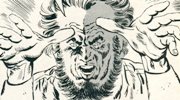
An Alphan madman takes hypnotic control of
aliens during a survey mission of a planet on the path of the
errant Moon.
Read the
brief story summary of "A Lonely Emperor" at Dark Worlds Quarterly
DIDJA KNOW?
"A Lonely Emperor" is a 15-page comic book story in issue #4 of
Charlton Publications black-and-white
Space: 1999 magazine.
Some of the art for this story, particularly the aliens, was
later borrowed for the
"Space Traitor" illustrated short story
in the Space: 1999
Charlton Press mini-book. The story there
is also similar, but with different characters and motivations
and swapping this story's original hypnosis plot for telepathic
mind control.
The story title on the contents page of the magazine mistakenly
refers to it as
"The Lonely Emperor".
CHARACTERS APPEARING OR MENTIONED IN THIS STORY
Commander Koenig
Professor Bergman
Dr. Mastambi
Dr. Edwards
Alan Carter
Omira Tal
Dr. Russell
Dr. Mastambi's lab assistant (mentioned only)
DIDJA NOTICE?
The opening paragraph of this story relates the nuclear
explosion that blew the Moon out of Earth orbit in
"Breakaway", segueing into the
second paragraph which reads, "Moonbase Alpha had the
capability of supporting life indefinitely...but from Cmdr.
Koenig to the youngest neophyte in the moonbase, their
deepest need was for another world...on which they could
live..." Possibly, the "youngest neophyte" may be
interpreted as as
Shermeen Williams, a junior scientist who is seen to be a
sort of adopted daughter of Professor Bergman in "A Matter
of Balance" and whose early story is told in the "Awe" comic
book adaptation of "Breakaway"
from
BLAM! Ventures.
In this story, the Alphans visit a planet
while passing through the Epsilon Rudea system. Epsilon
Rudea appears to be a fictitious star. The star is
identified as a K dwarf star, which are medium-sized,
long-duration stars that make their systems of interest to
science in
possibly harboring extraterrestrial life.
In comparing the Epsilon Rudea star, Dr. Mastambi
refers to Earth's sun as a G-O dwarf star. This is
not accurate. Earth's sun is a G-type star (sometimes
called yellow dwarf). There is no G-O designation in the
scientifically accepted spectral classification system.
O-type stars are massive blue-white stars hundreds of times
larger than our sun.
The character of Dr. Edwards is introduced on page 2 of the
story. Though not stated in the story itself, the story
description on the contents page of the magazine says he was
an unpopular man, disliked by most of the Moonbase crew
because of his intolerance and dominating ways.
On page 2 of the story, as the Eagle crew prepares to board
the ship to investigate the fourth world of Epsilon Rudea,
pilot Carter tells Commander Koenig that Omira Tal will
co-pilot "if that's agreeable." Koenig's response is that
he's delighted as Omira is "an excellent pilot...and a very
attractive one!" Borderline sexual harassment at Moonbase
Alpha...by it's commander, no less!
On page 5 of the story, Dr. Edwards seems to indicate that
Dr. Mastambi is able to speak Swahili.
On page 6 of the story, Koenig actually acknowledges that
the aliens would not be able to understand the English
language. In most of the
Space: 1999
stories, aliens always speak English for no logical reason!
Here, the aliens of Epsilon Rudea IV are telepathic and are
able to easily communicate with the Alphans in that manner.
On page 7 of the story, Dr. Mastambi tells Dr. Russell that
Dr. Edwards' resentment towards him began "shortly before
the Moon was destroyed by the nuclear explosion." Of course,
the Moon was not destroyed (his own current existence on the
Moon is testament to that!), just blown out of Earth orbit
in "Breakaway".
On pages 7 and 8 of the story, Dr. Mastambi reports there is
no O3 umbrella in the upper atmosphere of Epsilon
Rudea IV to filter out ultraviolet rays from the sun which
are dangerous to humans with prolonged exposure. O3
is also known as ozone and, in Earth's atmosphere, it does
absorb most of the ultraviolet rays from the sun. Excessive
exposure to ultraviolet can damage human skin and eyesight.
Dr. Edwards loses his mind and uses his hypnosis skills to
lead the natives of the planet to attack the Alphan survey
team. At the end of the story, Omira remarks that Dr.
Edwards was the victim of "space madness"...whatever that
is.
Back to Space: 1999 Episode
Studies
